
Making Public Realm Count
Chris McCallum on design approach for successful outdoor space in ME masterplanning.
'once dwell time starts to stretch into that 10 to 20 minute range it gives people the opportunity to stop, sit, meet.'

'Good design goes hand in hand with sustainability, with some vernacular developments using 40% less energy consumption'
urban vegetation, shading, wind and water can reduce the perceived temperate by over 10 °C'


How do we decide if public realm is working?
Part of our design process requires us to propose an approach to space which we believe is successful, but ultimately this is put to a litmus test in the way people will use it in reality. When it comes to public plazas, comfort becomes the main driver for a successful space, and when we design in challenging environments we need to have a robust toolkit to ensure that open spaces can provide adequate comfort.
In the hot and often humid climates of the ME region where temperatures regularly exceed 40 degrees, the idea of achieving the 23-28 °C sweet spot for outdoor comfort without relying on mechanical cooling seems intimidating. Ultimately, public space can switch off and are largely unused from 11am-4pm due to unbearable heat.
If you can take those completely unusable hours and make them even partially tolerable, you start to shift the equation. Add a few more comfortable hours into the day and suddenly the space has a different rhythm. Cooling strategies, even relatively simple ones, can extend use by two to four hours. That’s not a marginal gain, that’s the difference between a place feeling alive or empty for most of the day. We can’t expect to design in perfect conditions, but it’s interesting to consider the challenge of stretching the edge conditions.

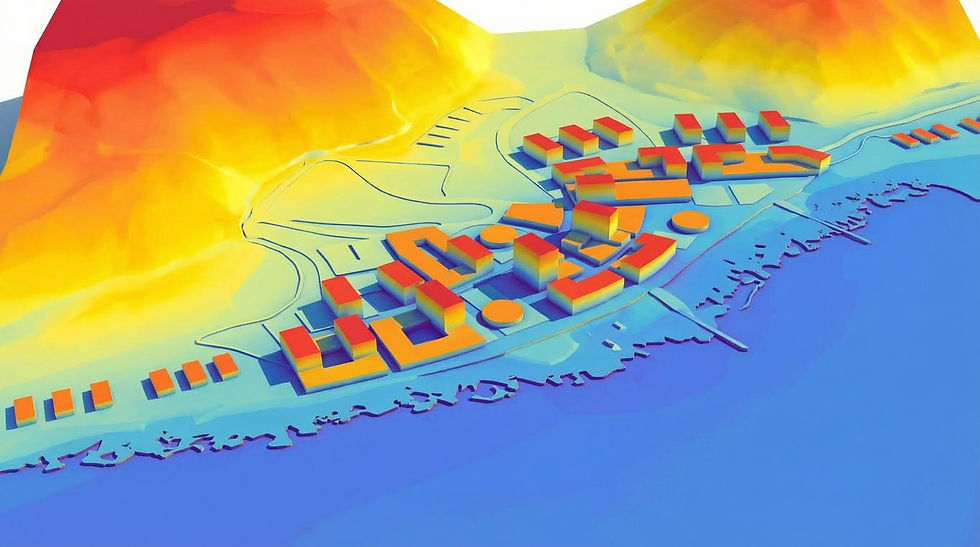

When considering a successful space, a lot of studies point to the same thing: If people are just moving through, spending a minute or two, the space isn’t really working as more than a corridor. But once dwell time starts to stretch into that 10 to 20 minute range it gives people the opportunity to stop, sit, meet. If a space supports the opportunity to be stationary in it then it could be seen as a success.


The gap between those two conditions is smaller than it sounds. Taking a space from a two minute pass through to five minutes of staying can be achieved with fundamentals of shade, air movement and materiality alongside the ambition to activate a space in a way in which people will want to use it.
This is why the concept of utilising ‘the vernacular’ is reoccurring across projects in region: narrow streets, proportions, internal courtyards, and intimately spaced buildings all respond innately to these millennia-old fundamentals. Good design goes hand in hand with sustainability, with some vernacular developments using 40% less energy consumption
Urban environments can create their own shade, orientation captures prevailing wind and air movement reduces the perceived temperature further. When you look at the potential that urban vegetation, shading, wind and water can reduce the perceived temperate by over 10 °C, the goal of making space for someone to stop in for 10 minutes becomes far more feasible.


And that’s where the toolkit comes in. If you consider successful public spaces in harsh environments, they rely not just on understanding that these tools exist but apply them to create something unique. Public realm has evolved past aesthetics and in has started in recent years to be driven by creating fluctuating uses throughout the day.
And maybe that’s the point that sticks. A successful public realm isn’t defined by how it looks in plan or in photographs, but by how long people choose to remain in it. Time becomes the real measure and so it makes sense that the projects that seem to have the most impact are those in which people are willing to stay, even just a little longer than they have to.
Which puts a different kind of pressure on design decisions. Not just to create space, but to shape conditions. To turn extremes into something more manageable. To take what would otherwise be a quick pass through and give it enough comfort, enough generosity, that it becomes somewhere people might actually pause.
Because once that happens, even briefly, the whole thing shifts. The space stops being a corridor and starts to become part of daily life. And that’s when the public realm really begins to count.
Chris McCallum is an architect with over five years of experience working in international design studios, with a strong focus on projects across the Middle East. His work spans architecture and masterplanning, where he delivers high-quality, thoughtful design solutions grounded in sustainability and user experience.
With a solid foundation in early-stage mixed-use concept design and hands-on involvement in later phases of large-scale residential developments, he brings a well-rounded perspective to complex projects. Chris works collaboratively within international, multidisciplinary teams and integrates computational design to create efficient, innovative, and data-driven design outcomes.